Industry Guides
CRM for Travel Agents and Tour Operators: Managing Enquiries, Quotes and Bookings
· ATTPL CRM Team
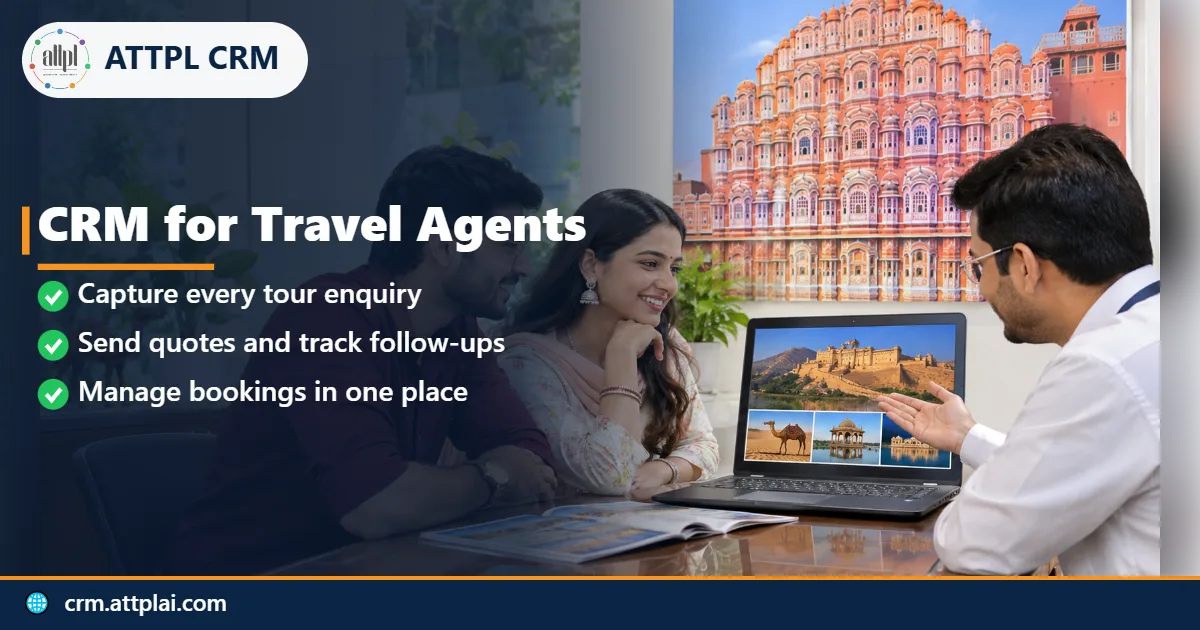
A travel business runs on enquiries. A family asks about Rajasthan or Kerala, a company wants a group tour, a couple wants a honeymoon package. Most of these people ask three or four agents at once, change their dates and compare prices. Without a system, enquiries are lost in WhatsApp chats and notebooks, and quotations are never followed up. A CRM brings order to the work and helps small agencies behave like organised businesses.
Why travel enquiries need a system
Travel is a high-value, high-consideration purchase. The customer may take days or weeks to decide, and the details keep changing: number of travellers, budget, hotel type, dates and places. One person in your office may handle the first call, another prepares the itinerary, and a third handles payments. Everyone needs to see the same history, or the customer has to repeat the story each time.
Capture enquiry details properly
Create a simple enquiry form in your CRM so that each lead is recorded in the same way. Useful fields include:
- Name, phone and preferred contact method
- Destination, travel dates and how flexible they are
- Number of adults and children, and any senior citizens
- Budget range and the type of trip: family, group, honeymoon, pilgrimage or corporate
- Hotel, transport and meal preferences
- Source of the enquiry, such as website, social media, referral or walk-in
Use tags such as 'Rajasthan', 'group' or 'honeymoon' so that you can filter leads later. Our guide on WhatsApp and CRM customer communication explains how to keep customer chats and the CRM record together.
Make quotations clear and track them
A good quotation lists the day-wise plan, hotels, transport, inclusions, exclusions, the total price and the validity date. Say clearly what is not included, such as entry tickets, personal expenses or taxes where applicable. Small unclear points create big arguments later.
Record every quotation in the CRM with the version and the date, and set a follow-up task for two or three days after sending it. Many customers do not reply because they are busy, not because they are uninterested. Our guide to quotation and proposal management gives a simple routine for this.
Move from enquiry to booking
Define a few stages for your pipeline, for example: new enquiry, itinerary sent, revised, advance pending, confirmed and travelled. Move the lead through the stages and look at where most leads stop. If many stop after the itinerary, your price or your follow-up may need a change. Keep the booking terms, such as the advance amount, cancellation rules and refund conditions, in writing and share them before taking payment. Also note which suppliers, such as hotels, drivers and guides, have been confirmed for each booking, because a confirmed customer with an unconfirmed hotel is a risk that the CRM task list can catch early.
Follow up on payments
Advance and balance payments are usually tied to dates. Record the due dates in the CRM and create reminders for your team. Send polite messages with payment details, and always give receipts. Our guide to payment collection follow-up shows how to remind customers without sounding rude. A simple sheet showing the amount received, the balance and the due date for each booking helps the owner see the cash position at a glance. Use only official, verified payment methods and never ask customers to pay into personal accounts that are not part of your business records.
Handle traveller documents with care
Travel businesses often receive identity documents, passport copies and addresses. These are sensitive. Collect only what you need, store it in a controlled place, limit access to the staff who need it, and delete it when it is no longer required. If you use the CRM for this, set user roles so that not everyone can see everything. Keep in mind the privacy rules that apply to your business, and take professional advice about your obligations.
Look after the traveller during and after the trip
Plan three touch points: a short message before departure with the final details, a check-in call during the trip for longer tours, and a feedback request after return. A happy traveller may post a review or recommend you to friends. A complaint noted early can be solved before it becomes a bad review. Record all of this in the CRM. Keep a short list of the places, hotels and drivers that customers praised or complained about, because this feedback improves the next itinerary you design.
Build repeat and seasonal business
Travel is seasonal, and your past customers are your best market. Save the date of each trip, the destination and the group type. Next year, you can message a family before the summer holidays with a new idea, or wish a couple on their anniversary. Use short, relevant messages and respect any request to stop. Ask satisfied customers for a referral and record who referred whom.
Frequently asked questions
Can a very small travel agency use a CRM?
Yes. Even one or two people benefit from having every enquiry, quote and payment date in one place with reminders.
Should we store passport copies in the CRM?
Only if you really need them, with restricted access and a clear process for deletion. Take professional advice on your legal obligations.
How many times should we follow up on a quotation?
Follow up a few times at sensible gaps, such as two days, a week and a fortnight. Stop politely if the customer says they are not interested.
Sources
This article is general business information and is not legal advice. Travel, tax and data protection rules may apply to your agency, so consult a qualified professional before finalising your processes.
Organise your customer relationships
Leads, contacts, follow-ups and pipelines in one workspace for Indian businesses.